
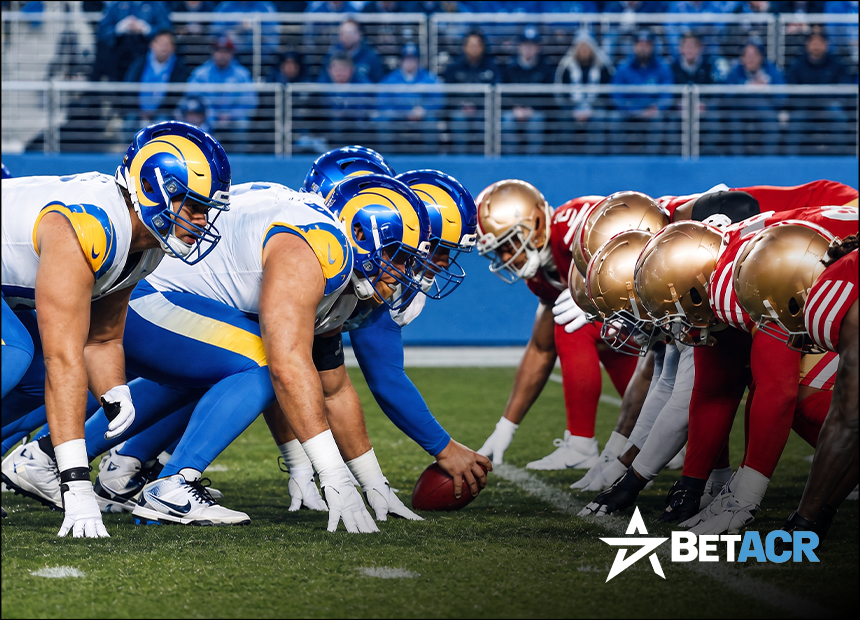


Point spread betting in the NFL works by handicapping the favored team with a number of points they must win by for a bet on them to pay out, while the underdog can lose by less than that number — or win outright — and still cover. What makes NFL spreads distinct from point spreads in other sports is the league’s scoring structure: touchdowns and field goals create predictable clustering around certain final-score margins, which is why NFL spreads are built, and bet, differently than spreads in sports with more continuous scoring.
How NFL Point Spreads Are Set and Displayed
A point spread in the NFL is shown as a negative number for the favorite and the same number as positive for the underdog — for example, a team favored by 6.5 points is listed at -6.5, while the underdog is at +6.5. Betting the favorite means they need to win by more than 6.5 points for that side to win; betting the underdog means they can lose by 6 points or fewer, or win outright, for that side to win.
NFL spreads carry standard odds, most commonly -110 on both sides, though this can shift based on how betting action is distributed and how sportsbooks adjust their pricing. The spread itself is set using statistical models, situational factors, and how sharp money moves the number in the days leading up to the game — it isn’t simply a prediction of the final score, it’s a price designed to balance action on both sides of the bet. A -110 price on both sides means a bettor needs to win more than 52.38% of similarly-priced spread bets over time just to break even, before any actual handicapping edge is considered.
Why “Key Numbers” Matter So Much in NFL Spreads
Under the NFL’s official scoring rules, a touchdown is worth six points, with an additional try worth one or two points, and a field goal is worth three points. Because scoring is built almost entirely around these values, certain final margins of victory occur far more often than others — a 3-point margin and a 7-point margin are the two most common outcomes in NFL history, followed by margins like 6, 10, and 14.
This is why NFL spreads frequently sit at or near 3 or 7, and why the half-point (“hook”) attached to spreads like -3.5 or -7.5 matters more in the NFL than in a sport with less predictable scoring patterns. A half-point spread eliminates the possibility of a push, but it also means the difference between -3 and -3.5 is meaningfully different in practice, since a 3-point margin is one of the single most likely outcomes of any NFL game.
A Realistic Example of an NFL Spread Bet
Suppose a sportsbook lists the home team as a -3 favorite against the visiting team at +3, both at standard -110 odds. A bettor stakes $110 on the home team to cover -3. Using the formula for negative odds, the profit if the bet wins is $110 × (100 ÷ 110) = $100, for a total payout of $210.
If the home team wins by 7 points, the bet on -3 wins outright, since the margin of victory exceeds the spread. If the home team wins by exactly 3 points, the bet pushes and the $110 stake is refunded in full — no profit, no loss — because this specific spread has no half-point attached. If the visiting team wins outright, or the home team wins by fewer than 3 points, the -3 bet loses.
How to Read and Apply an NFL Spread Before Betting It
Applying a point spread well in the NFL context means paying attention to more than just the number itself. Because of how heavily games cluster around key numbers, the difference between getting a team at -2.5 versus -3.5 can matter more than the difference between -7.5 and -9, even though the second gap is numerically larger — the first crosses a key number, the second doesn’t.
It also means paying attention to line movement specifically around those numbers: if a spread moves from -3 to -2.5, that’s a meaningfully different bet, not a minor adjustment, because it changes how a 3-point margin settles the wager. Bettors who track NFL spreads closely often pay particular attention to whether a line is sitting on, or has moved off, a key number before deciding when to place a bet.
Two NFL-specific factors that regularly move spreads are divisional matchups and weather. Divisional games historically tend to be closer than the spread might otherwise suggest, which is part of why sharp bettors treat them with extra scrutiny. Weather is more direct: heavy wind, rain, or snow tends to suppress scoring, which can push both the spread and the total lower as a game approaches kickoff.
Primetime and nationally televised games are another factor worth watching, since public betting interest tends to be heavier and more one-sided on these matchups than on an average weekday afternoon slate. Sportsbooks are aware of this pattern and sometimes shade primetime lines slightly to account for lopsided public money, which can occasionally create a small gap between the “true” line and the publicly posted one — part of why line shopping across multiple sportsbooks tends to matter more for high-profile games than for less-watched ones.
Common Mistakes Bettors Make With NFL Spreads
A common mistake is treating all half-point differences as roughly equivalent, without recognizing that moves across key numbers like 3 and 7 carry outsized importance in the NFL specifically. Another mistake is assuming a big favorite is close to a “guaranteed” cover, when NFL point spreads are specifically designed to make the outcome close to a coin flip at the listed number. Bettors also sometimes confuse the spread with the moneyline — covering a spread is a materially harder bet to win than simply picking the outright winner, since a moneyline bet only requires that team to win the game, not by any margin. Finally, it’s a mistake to ignore that NFL spreads can move significantly between when a game is first posted and kickoff, due to injury news or heavy betting action — a spread checked several days out may no longer reflect the price actually available by kickoff, particularly if a starting quarterback’s availability changes during the week.
Where NFL Point Spreads Fit Into the Bigger Picture
Point spread betting is one of the most heavily bet markets in the NFL because it’s designed to make close, competitive matchups out of games that might otherwise be lopsided on paper. Sportsbooks devote significant attention to setting and adjusting NFL spreads because the volume of betting activity on this market is so high relative to other options like totals or player props — often exceeding moneyline betting volume for the same game by a wide margin, since the spread is generally considered the default way to bet a football game.
Because the NFL only plays one game per team per week, each individual spread carries more scrutiny and betting volume than a comparable market in a sport with a denser schedule, like the NBA or MLB. This lower game volume also means public perception and media narratives around a specific matchup can influence where the betting public leans, which sportsbooks account for when setting and adjusting a line throughout the week — a well-known team on a winning streak may attract more lopsided public betting than the underlying numbers alone would justify, and a sportsbook has to weigh that public sentiment against its own statistical projection when deciding whether and how far to move a line.
Understanding how point spreads work as a general concept is a prerequisite to applying this NFL-specific context well — the mechanics of covering, pushing, and losing a spread bet are the same regardless of sport, but the numbers that matter most, and why, are shaped directly by how football is scored.
Frequently Asked Questions
What does +/- mean in point spreads?
The minus sign marks the favorite, who must win by more than that number of points to cover. The plus sign marks the underdog, who covers by winning outright or losing by fewer points than the spread.
What does a +7 spread mean?
A +7 spread means that team is a 7-point underdog. A bet on them covers if they win outright, or lose by 6 points or fewer. Losing by exactly 7 would push.
What is a +7.5 spread in the NFL?
A +7.5 spread means that team is a 7.5-point underdog. Because of the half-point, a bet on them covers by winning outright or losing by 7 points or fewer — there’s no possibility of a push.
What does +3.5 spread mean in football?
A +3.5 spread means that team is a 3.5-point underdog. A bet on them covers if they win outright or lose by 3 points or fewer — a 4-point loss or worse means the bet loses.
Is betting the spread the same as betting the moneyline?
No. A moneyline bet only requires the team to win the game outright, with no margin involved. A spread bet requires covering a specific point margin, which is a materially harder bet to win for a favorite.
Why do NFL spreads so often land on 3 or 7?
Because NFL scoring is built around 6-point touchdowns (plus a 1- or 2-point try) and 3-point field goals, final margins like 3 and 7 occur unusually often, making them “key numbers” sportsbooks price carefully around.